|
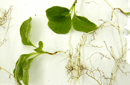
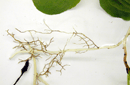
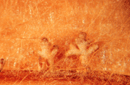
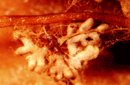
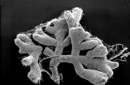
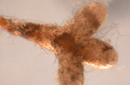
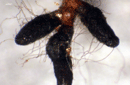
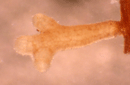
Laboratory experiments have shown that the fungal genome may influence the type of root tip branching induced in Arbutus menziesii (Pacific madrone) and Arctostaphylos uva-ursi (bearberry). In A. menziesii, the fungus Pisolithus tinctorius induces lateral root formation that results in complex root clusters, whereas the fungus Piloderma bicolor induces few laterals without the formation of root clusters. In A. uva-ursi, depending on the fungal species, either simple root systems with few unbranched laterals form or root systems with clusters of lateral roots develop. Field-collected roots of Arbutus menziesii and Arbutus unedo also show variable root branching patterns, presumably due to differences in fungal species forming the mycorrhizal association.
|