|
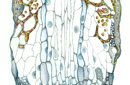
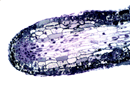
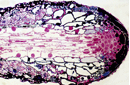
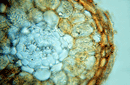
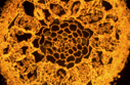
The main features of ectendomycorrhizas are the colonization of short roots (in Pinus inducing dichotomous branching), the development of a thin mantle, a Hartig net, and intracellular hyphae. The thin mantle may not be apparent when roots are viewed at low magnification. At higher magnification mantle features such as branching of hyphae can be seen. In early stages of mantle formation, hyphae may surround root hairs, while others can be seen embedded in a mucilage on the root surface. Extraradical hyphae are not usually abundant.
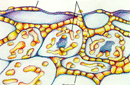
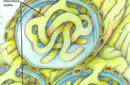
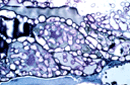
In sectional view, the mantle appears as a thin layer of hyphae partially embedded in mucilage, and the Hartig net develops as a uniseriate layer between epidermal and cortical cells. Frequently, most of the cortex is occupied by Hartig net hyphae. Intracellular hyphae develop within epidermal and cortical cells, forming a hyphal complex. Although extraradical hyphae do develop, the extent of their development in the soil has not been assessed, and there is no experimental evidence yet that they are involved in transport of nutrients to roots.
|