|
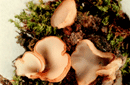
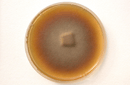
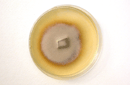
Initially, the fungi forming ectendomycorrhizas were grouped as E-strain fungi, mainly because sexual stages were not identified and only general morphological characteristics of hyphae and chlamydospores were used to characterize the isolates. With the discovery of sexual stages and with the use of molecular methods, a limited group of ascomycetes (Ascomycota) has been identified as fungal partners in ectendomycorrhizas. Most of the isolates of ectendomycorrhizal fungi belong to three species of Wilcoxina (W. mikolae var. mikolae, W. mikolae var. tetraspora, and W. rehmii) in the ascomycete order Pezizales. Another member of the Pezizales (Sphaerosporella brunnea) forms ectendomycorrhizas with Pinus contorta. Two genera in the Leotiales (Phialophora finlandia and Chloridium paucisporum) form mycorrhizas resembling ectendomycorrhizas. An interesting feature of several of these fungal species is that they
are able to form typical ectomycorrhizas with a number of conifer and angiosperm species. Therefore, although few fungal species are involved, many tree species could potentially form ectomycorrhizas. These fungal species are prevalent in forest habitats and in conifer seedling nurseries.
|