Under some circumstances (especially field conditions) many plant species harbour two or more different mycorrhizal associations. Some species may, in addition, have other symbioses with bacteria or actinomycetes that are able to fix atmospheric nitrogen. These features highlight the complexity of the interaction between plant roots and microorganisms.
|
|
Species forming arbuscular mycorrhizas and ectomycorrhizas
Plants that can be colonized by both arbuscular mycorrhizal fungi and ectomycorrhizal fungi are referred to as dual mycorrhizal species. Several angiosperm tree genera, including Alnus, Allocasuarina, Casuarina, Eucalyptus, Populus, and Salix show this characteristic. There are a few reports of ectomycorrhizal conifer species with sporadic arbuscular mycorrhizal structures in their roots. In the angiosperm genera, one mycorrhizal type may be dominant, depending on the developmental stage of the tree or field conditions. When both categories occur together, there is some evidence that each may perform a separate functional role. Three genera (Allocasuarina, Casuarina, and Alnus) have a tripartite relationship that includes colonization by the actinomycete Frankia, which is able to fix atmospheric nitrogen. This makes these species particularly valuable in the reclamation of disturbed sites and in stabilizing sandy soils.
|
|
|
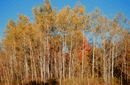 Populus tremuloides
|
|
-wil.gif) Salix sp.
|
|
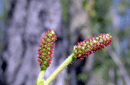 Alnus crispa
|
|
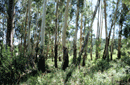 Eucalyptus sp.
|
|
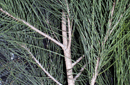 Casuarina glauca
|
|
|
|
|
|
|
|
|
Species forming both ericoid and arbuscular mycorrhizas
The hair roots of species in the families Ericaceae, Empetraceae, and Epacridaceae are typically colonized by fungi that form complex intracellular coils. However, in some Hawaiian species of Vaccinium (Ericaceae) and in Styphelia tameiameiae (Epacridaceae), hair roots can have typical ericoid mycorrhizal associations, while larger roots can be colonized by glomalean fungi. Typical intracellular structures, including arbuscules and vesicles, are formed in cortical cells of these roots.
|
|
|
 Styphelia tameiameiae
|
|
 Styphelia tameiameiae
|
|
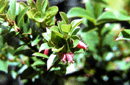 Vaccinium dentatum
|
|
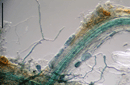 Vaccinium dentatum
|
|
 Vaccinium dentatum
|
|
|
|
|
|
|
|
|
Species forming ectomycorrhizas as well as associations with dark septate endophytes
Several typical ectomycorrhizal gymnosperm (Abies, Picea, Pinus) and angiosperm (Alnus, Betula, Fagus, Populus, Salix) genera can associate with dark septate root endophytes (DSEs) under certain soil conditions. Although the role of DSEs in these situations is unclear, there is some evidence from experimental work that DSEs may enhance the growth of some pine species.
|
|
Species forming arbuscular mycorrhizas as well as associations with dark septate endophytes
More than 500 arbuscular mycorrhizal plant species have been recorded as associating with DSEs; these include herbs, shrubs, and trees. Among these species are several legumes that also associate with nitrogen-fixing bacteria. Suggested roles for DSEs include nutrient uptake and protection from pathogenic fungi. How these fungi interact with arbuscular mycorrhizal fungi is uncertain.
|
|
|
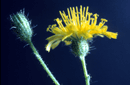 Hieracium pratense
|
|
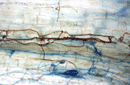 Hieracium pratense
|
|
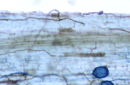 Hieracium pratense
|
|
 -
|
|
-
|
|
|
|
|
|
|
|
|
Species forming ericoid or orchid mycorrhizas as well as associations with dark septate endophytes
Many species in the family Ericaceae that occur in alpine, sand dune, or bog sites often have dual relationships with both ericoid mycorrhizal fungi and DSEs. In addition, several terrestrial orchid species that form typical orchid mycorrhizal associations associate with DSEs.
|
|
|
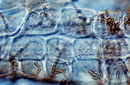 Gaultheria procumbens
|
|
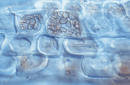 Gaultheria procumbens
|
|
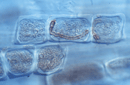 Gaultheria procumbens
|
|
-
|
|
-
|
|
|
|

|
|
|
|